
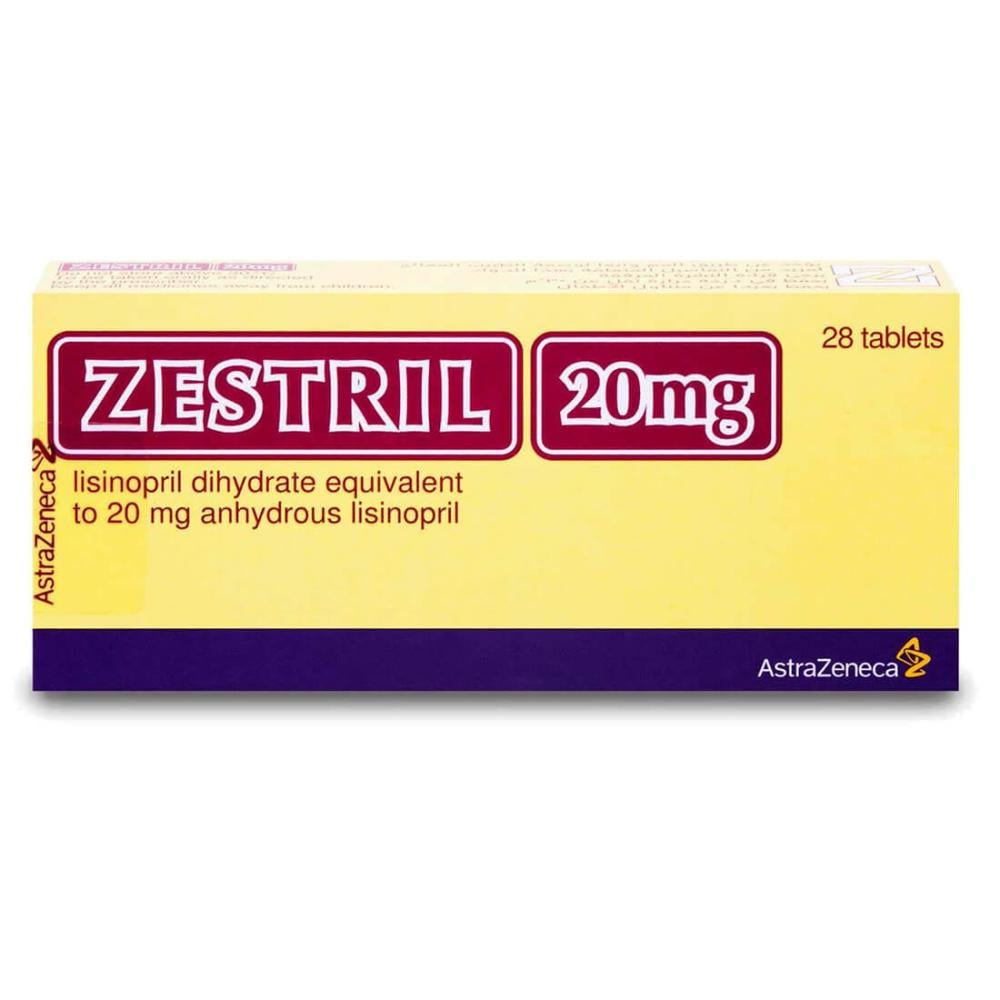
Zestril 20 mg 28 tablets

Lisinopril 20 mg tablets
What is lisinopril and what is it used for?
Lisinopril belongs to a group of medicines called angiotensin-converting enzyme (ACE) inhibitors.
It can be used for the following conditions:
• To treat high blood pressure (hypertension).
• To treat heart failure.
• If you have recently had a heart attack (myocardial infarction).
• To treat kidney problems caused by type 2 diabetes in people with high blood pressure.
It works by causing your blood vessels to widen. This helps lower your blood pressure. It also makes it easier for your heart to pump blood throughout your body.
Do not take lisinopril.
• If you are allergic to lisinopril or any of the other ingredients of this medicine
• If you have ever had an allergic reaction to another ACE inhibitor medicine. The allergic reaction may have caused swelling of the hands, feet, ankles, face, lips, tongue, or throat. It may also have made it difficult to swallow or breathe (angioedema).
• If you have taken or are currently taking sacubitril/valsartan, a medicine used to treat a type of long-term (chronic) heart failure in adults, your risk of developing angioedema (rapid swelling under the skin in an area such as the throat) may be increased.
• If a family member has had severe allergic reactions (angioedema) to ACE inhibitors or you have had severe allergic reactions (angioedema) with no known cause.
• If you are more than 3 months pregnant.
• If you have diabetes or kidney dysfunction and are being treated with a blood pressure lowering medicine containing aliskiren.
Warnings and precautions
Talk to your doctor or pharmacist before taking lisinopril if you:
• Narrowing (stenosis) of the aorta (an artery in your heart) or narrowing of the heart valves (mitral valves).
• You have a narrowing (stenosis) in your renal artery.
• Increased thickness of the heart muscle (known as cardiomegaly).
• You have blood vessel problems (collagen vascular disease).
• Low blood pressure. You may notice this as a feeling of dizziness or lightheadedness, especially when standing.
• You have kidney problems or are on dialysis.
• They have liver problems.
• I have diabetes.
• Taking any of the following medications used to treat high blood pressure: angiotensin II receptor blockers (ARBs), aliskiren
• You have recently had diarrhea or vomiting (sickness).
• You have high cholesterol levels and are undergoing a treatment called LDL apheresis.
• Are of black origin because lisinopril may be less effective. You may also more easily get the side effect "angioedema" (a severe allergic reaction).
Possible side effects of lisinopril
Common side effects
• Headache.
• Feeling dizzy or lightheaded, especially if you stand up quickly.
• Diarrhea.
• A dry cough that does not go away.
• Sickness (vomiting).
• Kidney problems (shown in blood test).
Other medications and lisinopril
In particular, tell your doctor or pharmacist if you are taking any of the following medicines:
• Other medications to help lower blood pressure.
• Angiotensin II receptor blockers (ARBs) or aliskiren.
• Water tablets (diuretics).
• Beta-blocker medications, such as atenolol and propranolol.
• Nitrate medications (for heart problems).
• Nonsteroidal anti-inflammatory drugs (NSAIDs) used to treat pain and arthritis.
• Aspirin (acetylsalicylic acid) if you take more than 3 grams each day.
• Medications for depression and mental problems, including lithium.
• Potassium supplements (including salt substitutes), potassium-sparing diuretics, and other medications that can increase the amount of potassium in the blood (such as trimethoprim and cotrimoxazole for infections caused by bacteria; cyclosporine, an immunosuppressant drug used to prevent rejection of transplanted organs; and heparin, a blood-thinning drug used to prevent clots).
• Insulin or medications you take by mouth for diabetes.
• Medications used to treat asthma.
• Medicines to treat nasal or sinus congestion or other cold remedies (including medicines you can buy at the pharmacy).
• Medicines to suppress the body's immune response (immunosuppressants).
• Allopurinol (for gout).
• Procainamide for heart rhythm problems.
• Medicines containing gold, such as sodium aurothiomalate, which can be given to you as an injection.
How to take lisinopril
Adults
Your dosage depends on your medical condition and whether you are taking any other medications. Your doctor will tell you how many tablets to take each day. Consult your doctor or pharmacist if you are unsure.
• For high blood pressure: The recommended starting dose is 10 mg once a day. The usual long-term dose is 20 mg once a day.
• For heart failure: The recommended starting dose is 2.5 mg once a day. The long-term dose is 5 to 35 mg once a day.
• After a heart attack: The recommended starting dose is 5 mg within 24 hours of the attack and 5 mg one day later. The usual long-term dose is 10 mg once a day.
• For kidney problems caused by diabetes: The recommended dose is either 10 mg or 20 mg once a day. If you are elderly, have kidney problems, or take diuretics, your doctor may give you a lower dose than usual.
Use in children and adolescents (6 to 16 years of age) with high blood pressure
• This medicine is not recommended for children under 6 years of age or for children with severe kidney problems.
• The doctor will determine the correct dosage for your child. The dosage depends on the child's body weight.
• For children weighing between 20 kg and 50 kg, the recommended starting dose is 2.5 mg once a day.
• For children weighing more than 50 kg, the recommended starting dose is 5 mg once a day.
• Swallow the tablet with a drink of water.
• Try to take your tablets at the same time each day. It doesn't matter if you take them before or after food.
• Continue taking lisinopril for as long as your doctor tells you to, as it is a long-term treatment.
How to store lisinopril
Keep this medicine out of the sight and reach of children.
• Do not use this medicine after the expiry date (EXP) printed on the blister and carton. The expiry date refers to the last day of that month.
• 5 mg, 10 mg and 20 mg: Do not store above 30°C.
• Do not dispose of medications via wastewater or household waste. Ask your pharmacist how to dispose of medications you no longer use. These measures will help protect the environment.