Future Health Pharmacy

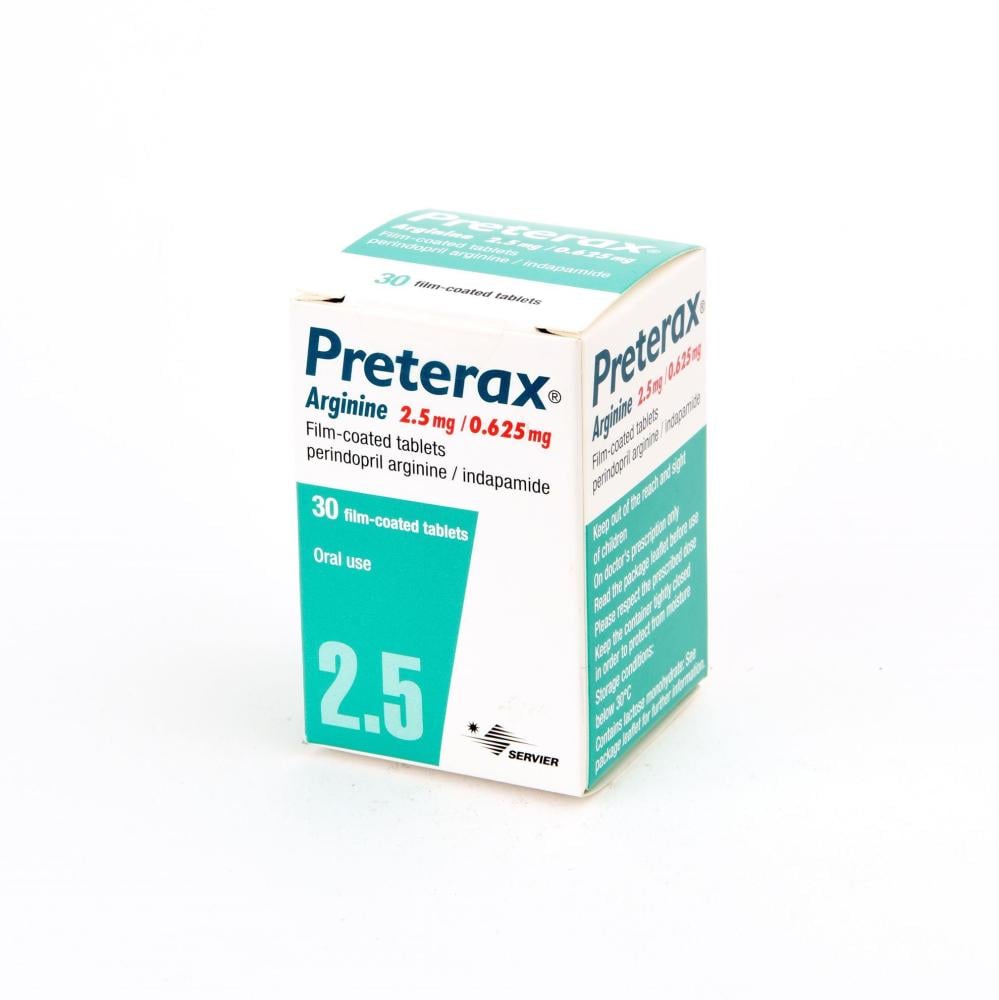
Preterax 2.5/0.625 mg 30 tablets

38.15

In Stock
Sku 1001986

38.15

Add to cart

Perindopril tert-butylamine 2.5 mg/indapamide 0.625 mg tablets


What is perindopril tert-butylamine/indapamide and what is it used for?

  • This product consists of two active ingredients; perindopril tert-butylamine and indapamide.
  • Perindopril is a drug that belongs to a class of drugs known as an "angiotensin-converting enzyme inhibitor"; it works by widening blood vessels, making it easier for your heart to pump blood through them.
  • Indapamide belongs to a class of drugs known as diuretics. Diuretics work by increasing the amount of urine produced by the kidneys.
  • Indapamide differs from other diuretics because it does not cause excessive urination.
  • This combination of active ingredients is used to help reduce and control blood pressure if you suffer from high blood pressure.

Do not take perindopril tert-butylamine/indapamide:

  • If you are allergic to perindopril, or any other ACE inhibitor, indapamide or any other sulfonamide compounds or any of the other ingredients of this medicine.
  • If you have previously experienced angioedema due to perindopril or another ACE inhibitor, consult your doctor. Angioedema is a condition characterized by signs and symptoms such as swelling of the face, throat, or tongue, wheezing, severe itching, or a severe rash.
  • If a family member has previously suffered from angioedema due to perindopril or another ACE inhibitor.
  • If you are more than 3 months pregnant.
  • If you have diabetes or kidney problems and are taking aliskiren (a drug used to treat high blood pressure).
  • If you have liver disease or have previously suffered from hepatic encephalopathy (a brain disorder caused by severe liver damage).
  • If you are taking sacubitril/valsartan (used to treat heart failure).
  • If you are breastfeeding.
  • If you suffer from renal artery stenosis (narrowing of the artery that supplies the kidneys with blood).
  • If you are using dialysis or any other type of blood filtration (depending on the type of filtration used).
  • If you are suspected of having untreated heart failure (the heart muscle is unable to pump blood properly to the body).

Warnings and precautions:

  • Stop taking the medicine immediately and talk to your doctor or pharmacist if you experience allergic reactions such as shortness of breath, skin rash, swelling of the face or neck, low blood pressure, and dizziness.
  • Talk to your doctor if you have hypertrophic cardiomyopathy (a heart muscle problem), aortic stenosis (narrowing of the main blood vessels that lead to the heart) or renal artery stenosis (narrowing of the artery that supplies the kidneys with blood).
  • Speak to your doctor if you suspect you have heart failure or other heart problems.
  • Speak to your doctor before starting this medication if you have liver or kidney problems or if you are undergoing dialysis.
  • Speak to your doctor before starting this medication if you have diabetes.
  • Speak to your doctor before starting this medication if you have a collagen vascular disease (a connective tissue disorder) such as scleroderma or systemic lupus erythematosus.
  • Speak to your doctor before starting this medication if you are on a salt-restricted diet or using salt substitutes that contain potassium.
  • Talk to your doctor before starting this medication if you are going to have LDL apheresis (removal of cholesterol from your blood using a machine).
  • Speak to your doctor before starting this medication if you are going to have surgery and/or anesthesia.
  • Speak to your doctor before starting this medication if you are going to undergo desensitization treatment to reduce the effects of wasp stings or bee allergies.
  • Speak to your doctor before starting this medication if you have an intolerance to some sugars.
  • Speak to your doctor before starting this medication if you have recently experienced vomiting, diarrhea, or dehydration.
  • Speak to your doctor before starting this medication if you are pregnant or planning to become pregnant.
  • Speak to your doctor before starting this medication if you have atherosclerosis.
  • Speak to your doctor before starting this medication if you have photosensitivity reactions (skin reactions when exposed to ultraviolet light).
  • Speak to your doctor before starting this medication if you are elderly.
  • Speak to your doctor before starting this medication if you have hyperparathyroidism.
  • Speak to your doctor before starting this medication if you have gout.
  • This medication is not recommended for high blood pressure in Black patients. It has been shown to increase the risk of angioedema and may be less effective in Black patients.
  • Be sure to tell your healthcare provider that you are taking this medication if you are going to have a medical test that requires an injection of an iodine-treated contrast agent (a substance used to make your organs, such as the stomach or kidneys, visible on X-rays).
  • Be sure to tell your healthcare provider if you experience any signs of glaucoma (high pressure in your eyes), such as changes in your vision or pain in one or both eyes, while taking this medication. If this happens, stop taking the medication and seek immediate medical attention.
  • If you are an athlete, taking this drug may result in a positive reaction in drug tests because it contains indapamide.

Possible side effects:

  • Rare but serious side effects include signs of an allergic reaction such as rash and itching, and angioedema (swelling with a red rash under the skin's surface in a localized part of the body on or near the hands, feet, lips, or eyes).
  • Low blood pressure, bronchospasm (chest tightness, difficulty breathing and wheezing), irregular heartbeat, pain in the jaw, chest and back as a result of physical exertion, and signs of pancreatitis (fatigue and severe abdominal and back pain).
  • Signs of liver problems (yellowing of the skin or eyes, white stools and dark urine) and signs of Stevens-Johnson syndrome (a rare and serious skin disease that usually begins with flu-like symptoms and is followed by a severe, painful rash with blisters).
  • Common side effects include dizziness, headache, vertigo, vision problems, pins and needles sensation, and tinnitus (noise in your ears).
  • Coughing, shortness of breath, nausea, diarrhea and constipation, indigestion, changes in taste, vomiting, abdominal pain, fatigue and muscle cramps.

Other medications and perindopril tert-butylamine/indapamide:

  • Tell your doctor or pharmacist if you are taking, have recently taken, or might take any other medicines, including nonprescription medicines, prescription medicines, herbal supplements, vitamins, and supplements.
  • If you are taking blood pressure medication (such as aliskiren).
  • If you are taking diuretics (used to increase urination).
  • If you are taking nonsteroidal anti-inflammatory drugs (used to reduce inflammation, pain and fever such as ibuprofen) or a high dose of aspirin.
  • If you are taking medications to treat diabetes (such as metformin or insulin).
  • If you are taking lithium (used for depression or mania).
  • If you are taking eplerenone (used to treat heart failure).
  • If you are taking potassium-sparing medications (such as spironolactone, amiloride, triamterene), use potassium-containing salt substitutes or potassium supplements.
  • If you are taking baclofen (used to treat muscle stiffness in diseases such as multiple sclerosis).
  • If you are taking corticosteroids or immunosuppressants (drugs used to reduce the body's defenses after a transplant or to treat autoimmune disorders such as cyclosporine and tacrolimus).
  • If you are taking medications to treat mental disorders such as anxiety, depression, and schizophrenia (such as antipsychotics and tricyclic antidepressants).
  • If you are taking heparin (a blood thinner).
  • If you are taking procainamide (used to treat irregular heartbeat).
  • If you are taking estramistin (used to treat cancer).
  • If you are taking allopurinol (used to treat gout).
  • If you are taking gold salts, especially when given intravenously (used to treat the signs and symptoms of rheumatoid arthritis).
  • If you are taking trimethoprim (used to treat infections).
  • If you are taking vasodilators, including nitrates (drugs to widen blood vessels).
  • If you are taking medications to treat asthma, shock, and low blood pressure (such as ephedrine, adrenaline, or noradrenaline).
  • If you are taking racecadotril (used to treat diarrhea).
  • If you are taking pentamidine (used to treat pneumonia).
  • If you are taking halofantrine (used to treat certain types of malaria).
  • If you are taking sacubitril/valsartan (used to treat heart failure).
  • If you are taking methadone (used to treat addiction).
  • If you are taking sparfloxacin or moxifloxacin (antibiotics).
  • If you are taking terfenadine, mizolastine or astemizole (anthistamines used for allergies or hay fever).
  • If you are taking vincamine (used to treat symptomatic cognitive disorders in the elderly, including memory loss).
  • If you are taking the medication bepridil (used to treat angina).
  • If you are taking medications to treat irregular heartbeats (such as amiodarone, quinidine, sotalol, hydroquinidine, disopyramide).
  • If you are taking cisapride or difemanil (for the treatment of digestive problems).
  • If you are taking digoxin or other cardiac glycosides (used to treat heart problems).
  • If you are taking calcium, including calcium supplements.
  • If you are taking stimulant laxatives (such as senna).
  • If you are taking amphotericin B by injection (used to treat severe fungal infections).
  • If you are taking tetracosactide (used to treat Crohn's disease).

How to take perindopril tert-butylamine/indapamide:

  • The recommended dose is one tablet orally once daily.
  • Your doctor may increase the dose to two tablets every day or change the dosing regimen if you have kidney dysfunction.

Usage instructions:

  • Take the tablet before food in the morning.
  • Take the tablet with a full glass of water.
  • Take the medication exactly as prescribed by your doctor. Consult your doctor or pharmacist if you are unsure.

How to store perindopril tert-butylamine/indapamide:

  • Keep the medicine out of reach of children and pets.
  • The medicine should not be stored above 30 degrees Celsius.
  • Discard the medicine blister two months after first opening the outer sachet.
  • Do not use the medicine after the expiry date stated on the carton.
  • Keep the medicine in its original packaging to protect it from moisture and light.
  • Do not use damaged grains.
  • Do not dispose of medicines in sewage or household waste.


Preterax 2.5/0.625 mg 30 tablets

38.15 SAR

Add to cart