
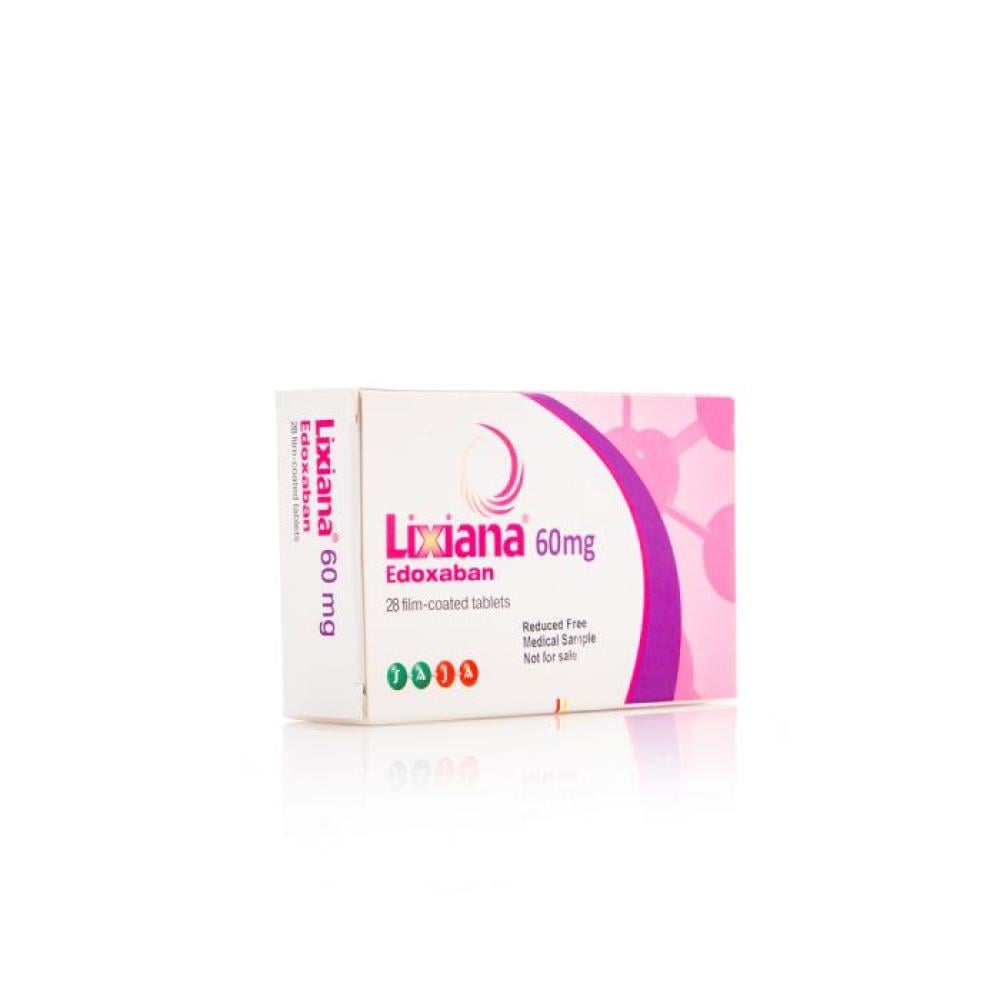
Lexiana 60 mg 28 tablets

Edoxaban tablets 15 mg, 30 mg, 60 mg
What is edoxaban and what is it used for?
Edoxaban belongs to a group of medications called anticoagulants. This medication helps prevent blood clots from forming. It works by blocking the activity of factor Xa, an important component of blood clotting.
Edoxaban is used in adults for:
• Prevent blood clots in the brain (stroke) and other blood vessels in the body if you have a form of irregular heartbeat called non-valvular atrial fibrillation and at least one additional risk factor, such as heart failure, previous stroke, or high blood pressure;
• Treatment of blood clots in the veins of the legs (deep vein thrombosis) and in the blood vessels of the lungs (pulmonary embolism), and to prevent recurrence of blood clots in the blood vessels of the legs and/or lungs.
What you should know before using edoxaban
Do not use edoxaban
• If you are allergic to edoxaban or any of the other ingredients of this medicine (listed in section 6);
• If you are actively bleeding.
• If you have a disease or condition that increases the risk of serious bleeding (such as a stomach ulcer, injury or bleeding in the brain, or recent brain or eye surgery);
• If you are taking other medicines to prevent blood clotting (eg, warfarin, dabigatran, rivaroxaban, apixaban or heparin), except when changing anticoagulant therapy or while heparin is being inserted through a vein or artery to keep it open;
• If you have liver disease that increases your risk of bleeding.
• If you have uncontrolled high blood pressure;
• If you are pregnant or breastfeeding.
Warnings and precautions
Talk to your doctor or pharmacist before taking edoxaban,
If you have an increased risk of bleeding, such as if you have any of the following conditions:
End-stage kidney disease or if you are on dialysis;
Acute liver disease.
Bleeding disorders.
A problem with the blood vessels in the back of your eyes (retinopathy);
Recent bleeding in your brain (intracranial or intracerebral hemorrhage);
Problems with blood vessels in the brain or spine.
If you have a mechanical heart valve.
• Edoxaban 15 mg is only used when changing from edoxaban 30 mg to a vitamin K antagonist (such as warfarin) (see section 3. How to take edoxaban).
Take special care with edoxaban.
• If you know you have a condition called antiphospholipid syndrome (an immune system disorder that increases your risk of blood clots), tell your doctor who will decide if your treatment needs to be changed.
• If you need to have an operation,
• It is very important to take edoxaban exactly before and after the procedure at the times your doctor tells you to. If possible, edoxaban should be stopped at least 24 hours before the procedure. Your doctor will determine when to restart edoxaban.
In emergency situations, your doctor will help you determine the appropriate course of action regarding edoxaban.
children and adolescents
Edoxaban is not recommended for use in children and adolescents under 18 years of age. There is no information on its use in children and adolescents.
Other medications and edoxaban
Tell your doctor or pharmacist if you are taking, have recently taken or might take any other medicines.
If you are taking any of the following:
• Some medications for fungal infections (such as ketoconazole).
• Medicines that treat abnormal heart rhythms (such as dronedarone, quinidine, verapamil).
• Other medicines to reduce blood clotting (such as heparin, clopidogrel or vitamin K antagonists such as warfarin, acenocoumarol, phenprocoumon or dabigatran, rivaroxaban, apixaban);
• Antibiotic medications (such as erythromycin).
• Drugs that prevent organ rejection after transplantation (such as cyclosporine).
• Anti-inflammatory and pain-relieving medications (such as naproxen or acetylsalicylic acid).
• Antidepressant medications called selective serotonin reuptake inhibitors (SSRIs) or serotonin-norepinephrine reuptake inhibitors (SNRIs).
If any of the above apply to you, tell your doctor before taking edoxaban, as these medications may increase the effect of edoxaban and the chance of unwanted bleeding. Your doctor will decide whether you should be treated with edoxaban and whether you should remain under observation.
If you are taking any of the following:
• Some medications to treat epilepsy (such as phenytoin, carbamazepine, phenobarbital).
• St. John's wort, an herbal product used for anxiety and mild depression.
• Rifampicin, an antibiotic.
If any of the above apply to you, tell your doctor before taking edoxaban, as the effect of edoxaban may be reduced. Your doctor will decide whether you should be treated with edoxaban and whether you should be monitored.
How to use edoxaban
Always take this medicine exactly as your doctor or pharmacist has told you. Consult your doctor or pharmacist if you are not sure.
How much do you take?
The recommended dose is one 60 mg tablet once daily.
If you have impaired kidney function, your doctor may reduce your dose to one 30 mg tablet once daily.
If your body weight is 60 kg or less, the recommended dose is one 30 mg tablet once daily;
If your doctor prescribes medications known as P-gp inhibitors: cyclosporine, dronedarone, erythromycin, or ketoconazole, the recommended dose is one 30 mg tablet once daily.
How to take the tablet
Swallow the tablet, preferably with water.
Edoxaban can be taken with or without food.
Your doctor may change your anticoagulant treatment as follows:
Switching from vitamin K antagonists (such as warfarin) to edoxaban
Stop taking vitamin K antagonists (such as warfarin). Your doctor will need to perform blood tests and advise you when to start taking edoxaban.
Switching from non-VKA oral anticoagulants (dabigatran, rivaroxaban, or apixaban) to edoxaban
Stop taking your previous medications (such as dabigatran, rivaroxaban, or apixaban) and start using edoxaban at the time of your next scheduled dose.
Switching from parenteral anticoagulants (such as heparin) to edoxaban
Stop taking anticoagulants (such as heparin) and start edoxaban treatment at the time of the next anticoagulant dose.
Switching from edoxaban to vitamin K antagonists (such as warfarin)
If you are currently taking 60 mg of edoxaban:
Your doctor will tell you to reduce your edoxaban dose to one 30 mg tablet once daily and take it with a vitamin K antagonist (such as warfarin). Your doctor will need to perform blood tests and tell you when to stop taking edoxaban.
If you are currently taking 30 mg (low dose) edoxaban:
Your doctor will tell you to reduce your edoxaban dose to one 15 mg tablet once daily and take it with a vitamin K antagonist (such as warfarin). Your doctor will need to perform blood tests and tell you when to stop taking edoxaban.
Switching from edoxaban to non-VKA oral anticoagulants (dabigatran, rivaroxaban, or apixaban)
Stop taking edoxaban and start a non-VKA anticoagulant (such as dabigatran, rivaroxaban, or apixaban) at the time of the next scheduled dose of edoxaban.
Switching from edoxaban to parenteral anticoagulants (such as heparin)
Stop taking edoxaban and start intravenous anticoagulation (such as heparin) at the time of the next scheduled dose of edoxaban.
Patients undergoing cardioversion:
If your abnormal heart rhythm needs to be restored to normal with a procedure called cardioversion, take edoxaban at the times your doctor tells you to prevent blood clots in your brain and other blood vessels in your body.
Possible side effects
Stop using the product and seek immediate medical attention if:
You develop hives, rash, chest tightness, wheezing, low blood pressure.
Like other similar medications (medicines used to reduce blood clotting), edoxaban may cause bleeding that can be life-threatening. In some cases, bleeding may not be obvious.
If you experience any bleeding event that does not stop on its own or if you experience signs of excessive bleeding (exceptional weakness, fatigue, paleness, dizziness, headache or unexplained swelling) consult your doctor immediately.
How to store edoxaban
• Keep this medicine out of the sight and reach of children.
• Do not use this medicine after the expiry date printed on the carton and on each blister after EXP. The expiry date refers to the last day of that month.
• This medicine does not require any special storage conditions.
• Do not dispose of medications via wastewater or household waste. Ask your pharmacist how to dispose of medications you no longer use. These measures will help protect the environment.