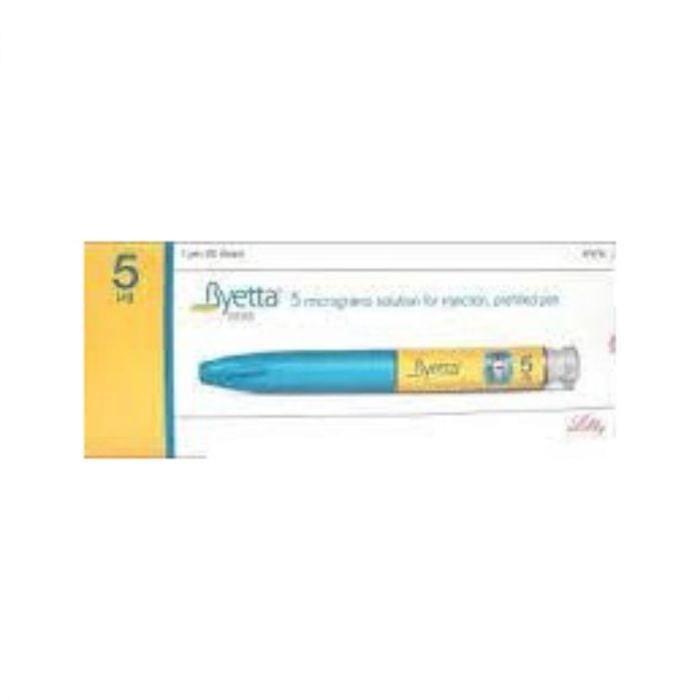
The primary mechanism of action of exenatide, as an incretin-like hormone or human glucagon-like peptide 1 analogue, is to increase insulin secretion when blood glucose levels are high, decrease glucagon secretion, and delay gastric emptying in an attempt to lower postprandial glucose levels.
Medical uses of Byetta 5 microgram pen
Your doctor may prescribe this medication as an additional medication to help control your blood sugar.
Continue to follow a healthy eating plan and exercise.
How to use Byetta 5 microgram pen
Before using the pen for the first time, your doctor or nurse will show you how to use the pen.
You can use exenatide at any time of the day, with or without food and drink.
Use exenatide at about the same time every day - choose a time of day that works best for you.
The best places to inject are the front of your waist (abdomen), the front of your thighs, or your upper arm.
Do not inject into a vein or muscle.
Do not mix exenatide with other injectable medicines (such as insulin).
Do not use exenatide with other medicines containing glucagon-like peptide-1.
Your treatment will start with a low dose which will be gradually increased.
Your doctor will evaluate your treatment on a regular basis.
Doses may be changed under special circumstances, so always follow your doctor or pharmacist's instructions.
If you take more medicine than you should, talk to a doctor or go to the hospital immediately.
If you forget to take a dose, take it as soon as you remember unless it is almost time for your next dose.
Do not take a double dose (two doses at the same time) to make up for a missed dose.
Side effects of Byetta 5 microgram pen
Although the following side effects are not common to everyone, some patients may complain of the following:
swelling of the face, tongue, or throat
rash and itching
difficulty swallowing
hives and difficulty breathing
Use of Byetta 5 microgram pen during pregnancy and breastfeeding
If you are pregnant or breastfeeding, think you may be pregnant or are planning to have a baby, ask your doctor or pharmacist for advice before taking this medicine.
Your doctor will discuss the potential risks and benefits of using this medication during pregnancy and breastfeeding.
Helpful tips for diabetics
All carbohydrates affect blood glucose levels, so it's important to know which foods contain carbohydrates. Choose healthy carbohydrate-containing foods and be aware of the portion size (amount of carbohydrates) required.
Reduce your salt intake. Eating too much salt can increase your risk of high blood pressure, which in turn increases your risk of heart disease and stroke. When you have diabetes, you're already at greater risk for all of these conditions.
Eat more fruits and vegetables. This can help you get the vitamins, minerals, and fiber your body needs daily to maintain your health.
If you experience symptoms of low blood sugar such as weakness, dizziness, increased sweating, rapid heartbeat, blurred vision, or difficulty concentrating, eating or drinking something containing sugar usually helps.
Warnings and precautions while using Byetta 5 microgram pen
Talk to your doctor or pharmacist before using this medicine if you:
suffering from acute heart failure
Are 75 years of age or older
You have kidney disease or are on dialysis
You have liver problems
You have a severe stomach or digestive tract problem that delays stomach emptying (called gastroparesis), or if you have inflammatory bowel disease.
You have diabetes, do not use liraglutide as a substitute for insulin.
You have or have had pancreatic disease
Tell your doctor or pharmacist if you are taking, have recently taken or might take any other medicines, including non-prescription medicines, prescription medicines, herbal supplements, vitamins and nutritional supplements.
How to store Bayetta 5 microgram pen
Keep refrigerated (2°C - 8°C)
Keep this medicine out of the sight and reach of children.
Must be stored in the original container to protect from moisture.
Do not use this medicine after the expiry date printed on the carton/blister/label. The expiry date refers to the last day of that month.
Your health in numbers
Random blood sugar test: A blood sample will be taken at a random time. Regardless of when you last ate, a blood sugar level of 200 milligrams per deciliter (mg/dL) or higher indicates diabetes. A blood sugar level below 140 mg/dL is considered normal, and a reading between 140 and 199 mg/dL indicates diabetes risk.
Fasting blood sugar test. A blood sample will be taken after you fast overnight. A fasting blood sugar level below 100 mg/dL is normal. A fasting blood sugar level between 100 and 125 mg/dL is considered prediabetes. If your blood sugar is 126 mg/dL or higher on two separate tests, you may have diabetes.
Oral glucose tolerance test: For this test, you fast overnight, and your fasting blood sugar level is measured. You then drink a sugary liquid, and your blood sugar levels are tested periodically for the next two hours.